
Routes blog
An interview with mentor Laura Collier-Keywood
Laura speaks to us about why she became a mentor and how she’s found the experience…
Routes chats to Laura Collier-Keywood, Head of Financial Planning and Analysis at Citizens Advice and a mentor on our Summer 2019 mentoring programme.
“She has such a positive view on the world. Even though she has been through some very difficult times she still remained positive and optimistic. Applying for jobs and going to interviews can be such a draining experience, and whilst she received a number of knock backs she would always remain really positive and viewed it as a learning experience. I'm so glad to be able to say that her persistence paid off and she was recently offered a role which suited her perfectly.”
Routes: Hi Laura! To start, could you tell us why you signed up to be a mentor?
Laura: I felt like I had skills and experience which I could share and help other women in achieving their goals. At the same time I was keen to develop my mentoring and leadership skills. I was also interested in the asylum system as it is something you hear a lot about, but I was keen to learn more and understand it from a more personal perspective.
Routes: How did you feel before you met your mentee?
Laura: I was quite nervous and apprehensive but excited to meet her… She was really easy to talk to and very open which really put me at ease. Our first meeting was really a chance for us to get to know each other a bit better and start setting some goals and expectations.
Routes: What is your mentee’s goal?
Laura: Her goal is to get a job, specifically within the finance sector as she has the relevant training and qualifications and has worked in this sector previously, but has been out of work for a while.
Routes: What do you most admire about your mentee?
Laura: She has such a positive view on the world. Even though she has been through some very difficult times she still remained positive and optimistic. Applying for jobs and going to interviews can be such a draining experience, and whilst she received a number of knock backs she would always remain really positive and viewed it as a learning experience. I'm so glad to be able to say that her persistence paid off and she was recently offered a role which suited her perfectly.
Routes: Would you recommend becoming a Routes mentor?
Laura: I can't recommend this programme highly enough! It's amazing to be able to be part of someone else's journey in achieving their goals whilst still learning invaluable skills yourself. I have really enjoyed it and found it invaluable.
Routes: Why do you think your employer sponsored you to become a Routes mentor?
Laura: Due to the leadership training and mentoring skills. I think leadership skills are really important and often training gets neglected. Mentoring enables you to work on a lot of different skills including listening, communication, feedback and interpersonal skills. With this course you get to put the skills into practice straight away as well as getting a real sense of purpose and fulfilment of doing something that really has an impact on other people's lives.
Nahida and Daniela's mentoring stories
Ahead of opening applications for our Autumn/Winter mentoring programme, we asked some mentors and mentees on our current programme to share their experiences so far.
The first in a series of ‘Routes mentoring stories’, in which mentors and mentees share their experiences.
Nahida (Comms Planning Director for M/Six) - mentoring Oyinlola
“We all get absorbed in our day to day lives… through programs like Routes you are able to step outside of your comfort zone and take on the challenge of making a difference.”
I had expressed frustrations to our Head of People [about] wanting to do more outside of work to make a difference to the lives of women. Having had such amazing opportunities and support in my life I wanted to be able to give something back in return… It’s hard for someone to start afresh, let alone not knowing how to start. In devoting some of my personal time and energy I thought it could make a small difference building up an individual's confidence and skills.
We all get absorbed in our day to day lives and whilst there are opportunities to make a difference in your own industry, through programs like Routes you are able to step outside of your comfort zone and take on the challenge of making a difference to the life of someone who lives in a completely different world to yours. Businesses need to give back to the wider society and not just help within their own industry.
[Before our first meeting I was] nervous, excited and apprehensive about whether I would be liked, whether I could really make a difference… We were both nervous, and I think our first meeting was about feeling comfortable to open up and just talk. I was blown away by the confidence of this young women who had faced so many obstacles.
Since then she landed two interviews, was offered both jobs and to top it all off we are both working to get her onto a Digital Marketing Course for her future career.
[I admire] her positivity and warmth. And how humble she is and doesn't realise how much she has achieved. Though she has been faced with so many obstacles, she keeps growing.
I have already recommended this programme to a client of mine. It’s an experience where you are given the chance to make a difference to another woman, and you get rewarded seeing that difference come to life. A few hours of your time can make the world of difference to someone else.
Daniela - mentored by Rachel (Development and Community Manager, Goldsmiths SU)
“Asylum seekers and refugees most of the time don't have information about things we would like to do, [like] studying or working in this country… Because of programmes like this, so many women are advancing a lot on all kinds of things.”
I had heard about the programme from my housemate last year who had a mentor herself. I have always been very sceptical about mentors but I decided to give it a go. I wasn't sure how a mentor could help me to find out things which were personal as well, for example understanding what I’m good at and what kind of jobs I could do.
[Our first meeting was] so natural. We shared things about ourselves and what we were hoping to get from each other. I thought she is so cool and friendly and can definitely help me. She has been amazing finding out all the information I needed, and now we are working on the last details about admissions to university.
Asylum seekers and refugees most of the time don't have information about things we would like to do, like studying or working in this country… I wouldn't get the same information myself about university, how I can apply for funding or voluntary work opportunities, jobs I can do after I study etc. It's very important that mentors keep that amazing work going to make us feel we belong and we are part of this society so we can give our contribution to this country. Because of programmes like this, so many women are advancing a lot on all kinds of things.
(N.B. Both mentees’ names have been changed for privacy reasons)

Routes featured in Marie Claire
Routes featured in the July issue ‘Women Who Win’
July 2019 #WomenWhoWin series

Poetry from Routes
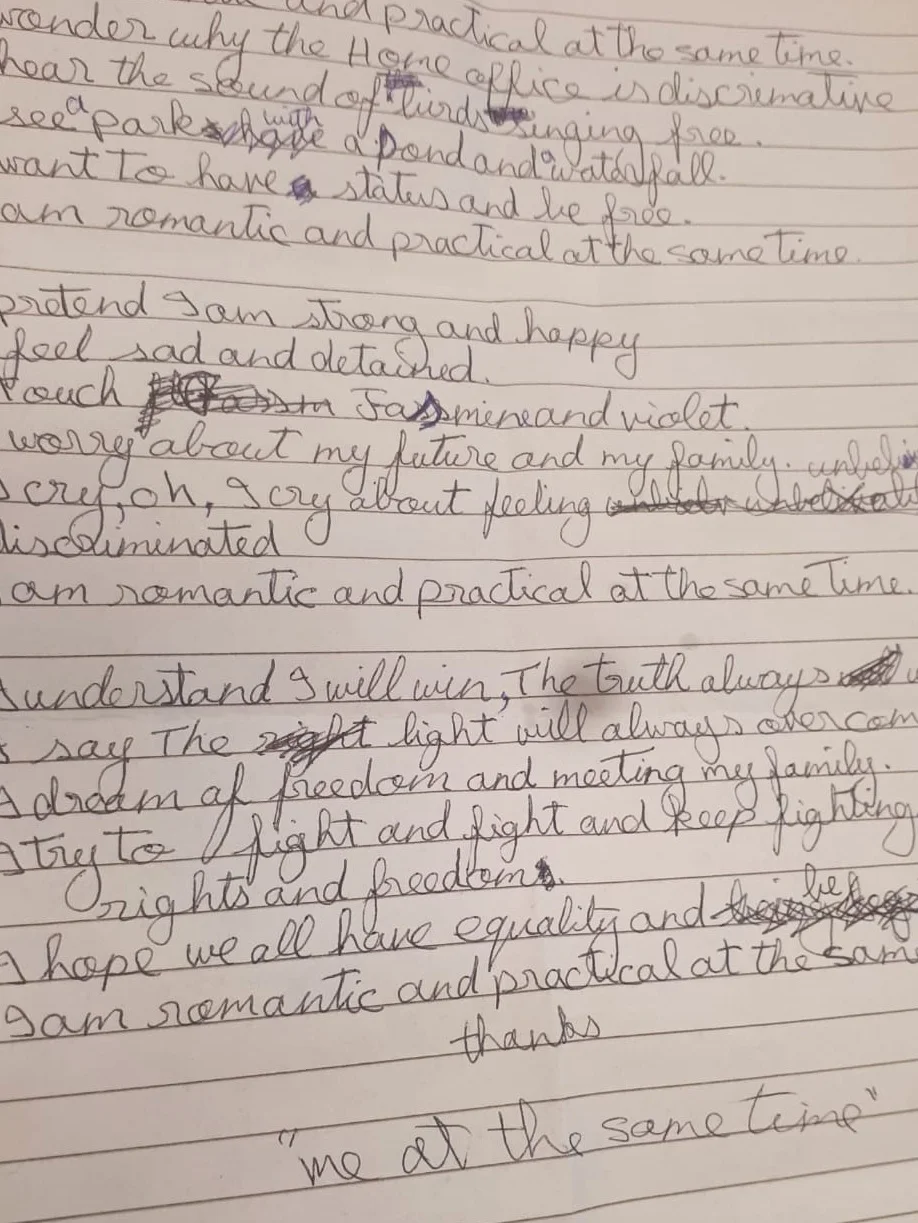
Two poems written by women (E.E. and Esther) in one of our weekly theatre workshops, hosted by the Young Vic.
On Friday 17th May at one of our weekly theatre workshops, we all wrote and performed poems about ourselves. Ahead of a summer break in our workshop series, we share two of these poems…
‘Me at the same time’ by E.E.
I am romantic and practical at the same time
I wonder why the Home Office is discriminative
I hear the sound of birds singing free
I see a park with a pond and a waterfall
I want to have status and be free
I am romantic and practical at the same time
I pretend I am strong and happy
I feel sad and detained
I touch jasmine and violet
I worry about my future and my family
I cry, oh, I cry about feeling discriminated
I am romantic and practical at the same time
I understand I will win, the truth always wins
I say the light will always overcome the dark
I dream of freedom and meeting my family
I try to fight and fight and keep fighting for my rights and freedom
I hope we all have equality and be free
I am romantic and practical at the same time
‘I am funny and hospitable’ by Esther
I am funny and hospitable
I wonder why there is inequality
I hear my son giggle
I see my husband smile
I want to travel the world
I pretend to be strong within
I feel like skiing
I touch my love’s chest
And I worry about the future
I cry when I am not believed
I am funny and hospitable
I understand life isn’t fair
I thank god we always make a way
I dream I live in a mansion
I try making people happy in my own way
I hope for a better tomorrow
I am funny and hospitable

What is purposeful leadership?
We believe great leadership starts with joy, welcome and patience. Hear more about why we think this and how it affects the way we lead.
Routes grows compassionate leaders, supporting everyone we work with to lead with purpose, according to our three key values: joy, welcome and patience.
Joy
We believe that great leaders bring joy to everything they do. They make experiences delightful; they default to optimism and positivity; they bring a smile to their work and uplift those around them. One of our faculty members, Cat, once described mentoring as leading by, ‘flying another person like a kite, not walking them on a lead.’ We believe our mentors help their mentees to fly through joy.
Welcome
We don’t stick to many rules at Routes, however there is one rule we do keep: welcome every new person who enters the room. We believe that a sense of genuine welcome is the foundation on which we are all able to flourish. Feeling welcomed, held and supported enables us to take risks, make mistakes and open up our minds to new and exciting possibilities. From sitting in circles where everyone can be seen, to learning people’s names; from thanking people for their contributions, to catching people up on what they’ve missed – we know that leaders who lead with small acts of welcome make all the difference.
Patience
Each one of us has a different lived experience, different core values and beliefs, different memories and associations, different skill sets and habits, different likes and dislikes. Our understandings and measures of ‘success’ therefore differ too. We believe that compassionate leadership has a respect of this at its core. We support our mentors to lead with patience, driven by an awareness (and a celebration) of the nuances and complexities of what it means to be human.
If you would like to develop your compassionate leadership skills, why not apply to become a Routes mentor or get in touch to discuss how we could train your future leaders.

When business and purpose align: existing at the intersection of profit and purpose
How the corporate and non-profit sector can work together for a bigger impact
“If you want to develop a good relationship with a corporate, sometimes you just have to create an opportunity that works for them, even if it doesn’t really do much for you.”
“I know a charity that has a single wall that different corporate groups regularly come to paint over.”
I’m at a breakfast conference about Corporate Social Responsibility (CSR) and how businesses can work with charities to make social impact, whilst simultaneously making their employees feel more fulfilled and ‘purposeful’. I’m not hearing the above statements for the first time, so I’m not surprised by them. But I am still disappointed. In the conversation between nonprofits and corporates, there always seems to be a clear and unchallenged power dynamic, wherein the corporate has the goods and the nonprofit must, like an award-winning contortionist, bend itself to fit the corporate’s needs and wants.
And to some extent it’s true - there are things that big corporate companies have that smaller charities, social enterprises and community groups do not - namely money and people-power. But I believe the same is true in reverse - that charities, social enterprises and community groups have huge amounts that large corporate organisations do not, and that they should be confident in that too.
This is, of course, not a new or radical thought. I have heard great examples of large companies partnering with nonprofits on national campaigns; from Network Rail and Samaritans working to reduce suicides on train tracks, to Autistica and Deutsche Bank collaborating to get more young people with autism into banking. Both of these are examples of corporates relying on the knowledge and insight of charities to deliver work with great social impact and real business benefits to the corportates: fewer suicides leads to fewer train disruptions and happier drivers, whilst supporting some of the 77% unemployed autistic adults into work enables them to contribute their unique skill sets to currently non-neurodiverse workplaces. But these collaborations take huge amounts of time, money and resources and often take on a life of their own outside of the core work of the charity or business.
Most corporates today will talk openly about their commitment to CSR, acknowledging that good volunteering, fundraising and community engagement opportunities help them to attract and retain their workforce by making them feel more fulfilled and ‘purposeful’, as well as giving their employees wider and more diverse insights and experiences, particularly if they are interacting with a range of customers or clients in the work that they do.
So why are nonprofit organisations still being asked if large groups can come along for a day to paint walls, pick up litter or ‘join in’? Why does criticality so often go out of the window when we are thinking about employee volunteering or CSR?
I am convinced that the truly fulfilling, mutually beneficial, impactful, insightful and rewarding stuff takes time and is simply not as effective when done at large scale. A commitment to ‘doing good CSR’ is, in my opinion, a commitment to meeting the charities, social enterprises or community groups that you want to support half way and being open to the idea that you won’t be able to involve your entire company at once (or you will be able to, but that it will basically be an away day with the possibility of some small scale social impact at the end - take a litter picking day, for example, or the painting/tidying of a communal area of a community centre). Not only is deeper, more thoughtful engagement significantly more beneficial to the charities and the individuals/communities they are fighting for and with, but the effect on the business will be infinitely greater too, because we can all tell when the work we are doing has real impact - we get more meaningful insights, we learn more, we feel more fulfilled and grateful and we are more likely to continue engaging with the cause (and the business) in the future. In other words, the company wins, the charity wins and the individual wins.
I speak from the perspective of a small social enterprise looking to make genuine impact in the lives of women seeking asylum in the UK whilst offering a truly valuable and fulfilling learning experience for women from business and organisations, private, public and third sector alike. We have crafted a mentoring programme which has maximum impact on both sides, taking responsibility off the shoulders of the CSR manager (or equivalent) by training and supporting all of our mentors (their employees) ourselves. Yet we still come up against the challenge of large organisations wanting to involve the maximum number of employees, usually for a relatively short amount of time.
I believe it’s time to start envisioning a type of charity-corporate partnership where both sides are looked at as equal partners, where we acknowledge that genuinely mutual impact takes time and energy, and where we start thinking beyond wall painting to look more critically at how we are building and maintaining these relationships.
Stories from our mentoring programme
A look back at the achievements of our mentees and mentors from our first programme
Our first mentoring programme finished in December 2018 with a big celebration; mentors, mentees, friends and family came together and shared a delicious home cooked meal together.
Read some of the stories of what our mentee/mentor pairs got up to on the programme below…

Sarah and Harriet
Sarah has been doing work experience with the events team in Harriet's work space, which has helped with her self-confidence and means that she now has references to add to her CV. One of Harriet's colleagues donated a laptop, which Sarah uses for online courses to boost English and Maths skills.
Woin and Hanna
Woin and Hanna worked on the business plan and social media for Woin's vegan catering company. Having run her own food business in the past, Hanna was well placed to support Woin to submit a grant application, improve her social media presence and think about how her catering menu is presented.
"She showed me and taught me how [to make a] financial business plan with her time and effort, which I couldn't be able to do without her help. I really appreciate both Hanna and Routes" - Woin, 2018 mentee

Nicole and Adama
Nicole supported Adama to put in an application for a free laptop, which was successful. Using Adama's new laptop, Nicole supported Adama to improve her digital skills, in particular Excel and word processing, which will help Adama to apply for volunteering opportunities.
"She helped to take away sadness that I was going through at that moment, help me to get a laptop that I can use at college for my assignments and for English improvement, and took me to visit places that I had never seen. She always in a smiling mood to me." - Huri, 2018 mentee talking about her mentor Jen
Apply to be on our next programme here
2018 Year Review
It’s almost the end of 2018 and we’ve taken some time to reflect on the year just gone and all the amazing people who have made it all possible…
looking back…
“Before I am so cling to myself - I don’t want to talk, I don’t want to… but the sessions help us to lose our inhibitions and release the tension. Like, you get to meet new people and you build confidence as well and then people show their personality...” - Rachel, workshop participant

…2018 has been a big year for Routes
We’ve worked with almost 150 women across London from over 30 different countries; we’ve run over 60 hours of free theatre workshops; we’ve facilitated over 100 hours of mentoring meetings and delivered 12 hours of training.
We’ve received generous support from the Paul Hamlyn Foundation, UnLtd, the Funding Network, Year Here and Allia Future Business Centre; we’ve been listed amongst the top 100 Women in Social Enterprise and been interviewed by the Guilty Feminist, the Linguist journal and Shado magazine. (All linked below)
We’ve met some amazing people, who have supported us in our mission, and we’ve built relationships that will last for years to come.
“Everything we do just adds to your day whereas if you are at home on Friday just looking at the ceiling, nothing to do... And everyone has been amazing, they’ve been supportive, even outside this room. If you have any personal issues you just call them and they always like pick up so yeah, it has been an amazing experience so yeah, I love it.” - Betty, workshop participant
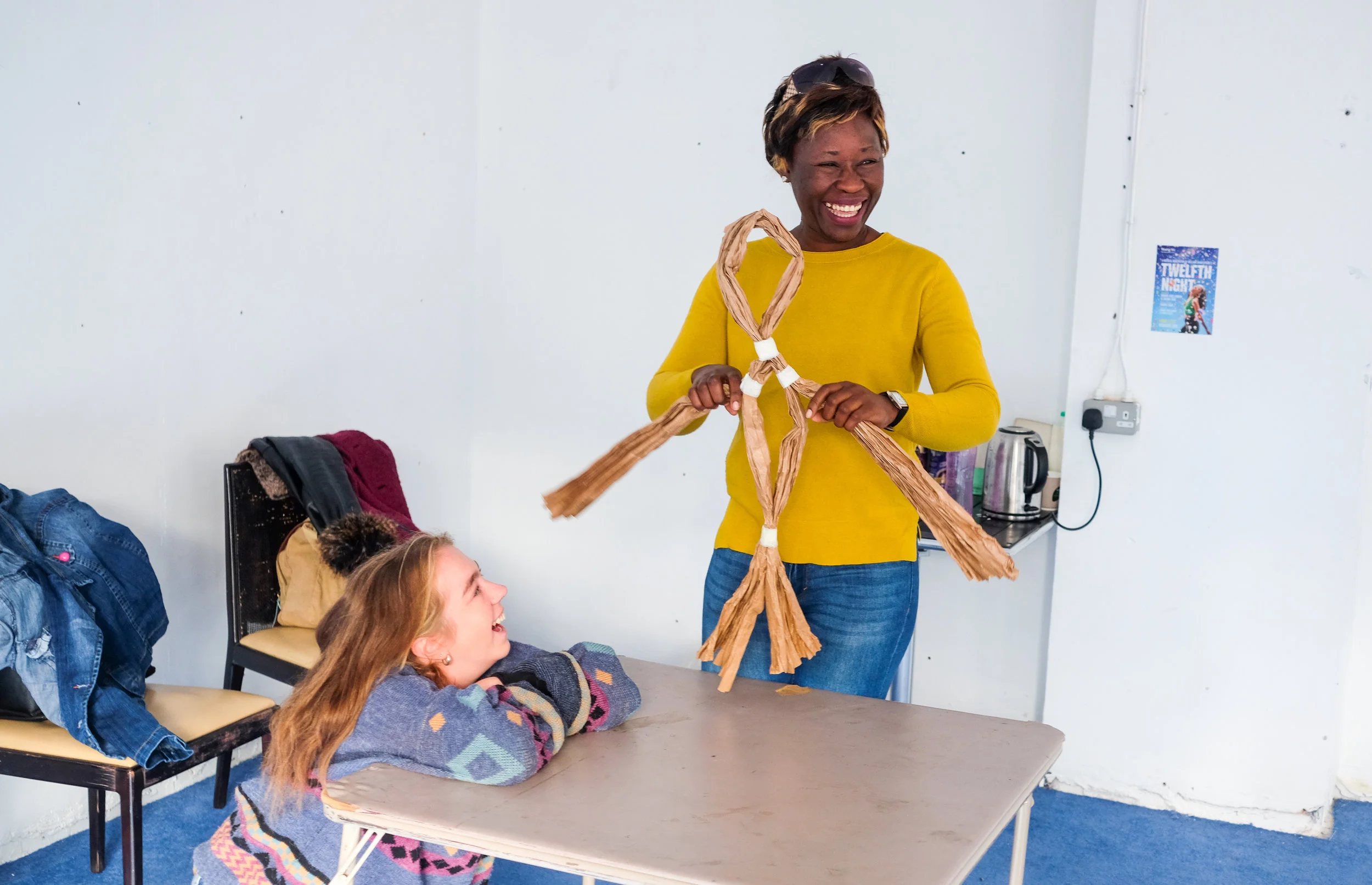
We’ve made puppets, sung songs, watched plays, heard stories, told stories, laughed (a lot), introduced people, been introduced to people, heard praise and criticism and been inspired to do more and think big.

Last week, we celebrated the end of the year with 30 phenomenal women, who have been part of our journey for the past three months. Alongside weekly theatre workshops, generously hosted by the Young Vic Theatre, 15 mentor-mentee pairs have been meeting since October. These pairs have achieved extraordinary things - from completing work experience placements and sourcing free laptops, to attending theatre trips and correcting homework, from launching new businesses to applying to university - you name it, our women have done it. We are so immensely proud of them all, and grateful for the support and warmth each mentor has extended to their mentee.
“It has been great to get to know my mentee and to provide a space for her that I hope I have made supportive and open to her needs and direction. It has felt… so important to be made more aware of the challenges faced by refugees in our difficult and sometimes horrifically unfair system. The training sessions were all excellent and we were given space to discuss our needs and concerns.” - Anne-Marie, Routes mentor
We know that it’s not just mentees who have benefited from the process: our mentors have told us they feel they have become better, more confident communicators; they have developed patience and compassion; they feel more fulfilled in their day-to-day life and infinitely more grateful for the opportunities they have, from going to work to attending a concert or meeting friends. Many of the 15 mentoring relationships will be continuing as friendships beyond the end of the programme. Knowing that our programmes are creating more compassionate, connected communities brings us so much joy.

Finally, we want to extend a huge thank you to everyone who has supported us in 2018 - without you, none of this would have been possible. To our advisors and mentors, faculty, training day panelists, fellow social entrepreneurs, friends and family - thank you for being a part of our journey this year, we can’t wait to share our plans for 2019 with you…
It’s going to be another big one.
Leyla and Daisy
Links:

Harriet's mentoring experience
Routes mentor Harriet Gridley writes about her experience of the Routes mentoring programme so far.
Harriet Gridley shares her experience as a Routes mentor.
Harriet is Head of UK Business Development for the Norwegian startup, No Isolation.
My mentee and I met for the first time in October 2018. We have laughed about it since, but we had both worried about how to greet each other for the first time. Becky made this easy for me - we settled on a big hug, which set the tone for our relationship. We’re over half way through the 10 week programme now, and I’d like to share how transformational it has been, for us both.
Routes is a social enterprise dedicated to helping female asylum seekers and refugees to advance within a stifling migration system. The mentorship arm of the organisation pairs up women, who then meet weekly, to identify and work towards a series of goals, big or small, professional or well-being related. Simultaneously, mentees attend theatre workshops to build confidence and practice english skills, and mentors are taught about the complexities of the asylum process in the UK, and are trained in techniques for effective and compassionate mentorship.
Becky is a warm hearted and driven person. She loves to sing, and has a dream to work with children. Due to situations out of her control, she is also an asylum seeker, and that’s put her life on hold. She hopes to be granted refugee status soon, which would at least mean she’d have the legal right to work. But in the meantime, she lives off £5 a day, and is restricted in everything she does. For her it can be a battle to wake up each morning, and find hope or meaning for the day ahead.
We meet each week in a cafe, to work towards tangible goals that improve her wellbeing, and importantly to demonstrate progression in her life, when often her situation can feel stagnant and infinite. Together we have identified three areas to focus on:
Education
Work experience
The fun stuff
We’ve had some great successes so far, and I think that is largely down to Becky’s positive attitude of trying anything and everything, despite nerves or low moods.
A member of my work space was kind enough to donate a laptop, which Becky now uses to follow online courses to boost her English and Maths, and delve into other areas of interest. Becky has also been doing regular work experience with The Trampery, which has helped with self-confidence and meant she could add some references on her CV. Lastly, Becky has joined a choir, attended a jazz gig and has been to the cinema, all at the expense of kind folk who were happy to provide her these experiences for free.
Despite these positives, the mentoring process has sometimes been frustrating. My mentee’s struggles are caused by a complex and seemingly unchangeable system. Sometimes it can feel like what Becky and I are working on only counts for 2% of what really matters, that I can’t help her with the 98% that really matters, which is her asylum case, acquiring the rights to work and making a life here in the UK.
Nevertheless, over the past six weeks, I have been happily surprised by people's willingness to help. And I have been lucky to witness the gratitude with which these acts of kindness are received. My weekly meetings with Becky have become the highlight of my week.
By Harriet Gridley

Theatre review: Twelfth Night
On Tuesday 30th October, a 17-strong group of Routes women watched ‘Twelfth Night’ at the Young Vic theatre. This is what we thought.
“…the show made my week like lovely. I was just thinking about love and to be honest it is a big deal because after the show my thinking was even like different, I was like, ‘wow, love’. My week went really smoothly… it did something to me! It did something to me so I loved it...”
* * *
On Tuesday 30th October, a 17-strong group of Routes women went to see ‘Twelfth Night’ at the Young Vic in London. Each one of these women had previously joined us for six of ten weekly theatre workshops, aimed at improving English language, increasing confidence and building new social connections.
At Routes we believe that doing theatre can be an incredible tool for achieving all of these things. But we also know how important witnessing theatre can be: the power of seeing yourself and your experiences played out in front of you; the joy of escapism; the gift of new, wider perspectives; the magic of being pulled into a story…
Kwame Kwei-Armah and Shaina Taub’s ‘Twelfth Night’ uplifted us, gave us hope, and made us laugh, sing and dance. We all left the theatre that night beaming.
At our workshop on Friday 2nd November, Routes’ co-founder, Daisy, interviewed eight women who attended the show, to find out what they loved so much. Below is a transcript of what was said.
Routes women review Twelfth Night
B: The show was amazing, particularly the ending, they make it look so real, like they fell in love and everything was OK at the end. I loved the chemistry between the actor and the actress was really real; they made me feel like at the end, OK there’s still hope for love, so I like that part. Their chemistry, working together, is amazing. So I like the whole show.
Daisy: How did the show make you feel?
R: Oh my god happy. The whole thing it’s funny; really nice love story. You know? It’s reality. Some people you love someone and they love somebody else, but in the end this one is happy.
I: I don’t remember, the… you know the funny one who comes in the stockings? Laughter. Malvolio? Malvolio, yeah! I really like him. His facial expression and his acting was so funny.
Laughter and chatter
I really like him and also all the funny parts. I really like it. It was like, you can’t even tell that time is flying; one and a half hours, it was like ten minutes.
R: I like the big guy!
A: Yeah! I like him as well!
Laughter
Daisy: And how did it make you feel, the play?
F: Breathtaking. I was just… I couldn’t think of any mistake. I thought everything was just conducted brilliantly. Excellent.
Daisy: Anyone else?
M: The whole performance are really great. It’s really... They done really, really well.
S: And also when Olivia got married with Sebastian! Laughter. It was so funny! And really nice, yeah.
L: It was first time for me. I saw…
Daisy: The first time you went to the theatre?
L: Yeah.
Daisy: What did you think about the experience?
L: It’s good!
D: Would you go back again?
L: Yes, of course. This is the first time all my life. Not… I didn’t ever go to the theatre in the past.
Daisy: Really? How many people it was their first time to the theatre?
A: Me!
S: In this country, yes.
L: Also in my country we didn’t have theatre.
Daisy: Does anyone have any final comments they want to make? Becky, What did you say to me when you came in today and I asked you how your week was?
B: I said the show made my week like lovely. I was just thinking about love and to be honest it is a big deal because after the show my thinking was even like different, I was like, ‘wow, love’.
Laughter
B: No to be honest my week went really smoothly. Even the next day I was like bang on dressed up, let’s go out and stuff. So yeah, it did something to me! It did something to me so I loved it.
I: Did you find love?!
B: Don’t worry about that…
Laughter
‘Twelfth Night’ runs at the Young Vic until 17th November 2018. Tickets here.
Autumn Cohort Training Highlights
Read the highlights of our Autumn 2018 Mentor Training Sessions.
At the start of October, Routes’ Autumn Cohort of mentors met for the first time, ready to embark on their ten-week mentoring journeys together. Our mentors come to us from a huge cross section of organisations; from public sector to private sector, large corporates to small start-ups. Despite their different backgrounds, this 15-strong group of women all share the compassion, commitment and dedication that characterise Routes mentors.
Session One: An Introduction
Our first session was all about introductions, both to our mentors and to the programme itself. We explored the foundations underpinning Routes mentoring and the expectations of our mentors and mentees.
Undoubtedly, the highlight of this session was hearing from Olivia Head (Regional Coordinator at Breaking Barriers and Co-Founder of Bread & Roses) who walked us through the intricacies and complexities of the asylum process in the UK, covering the different legal statuses and the rights attached to each one. Our mentors had the chance to ask questions and understand the context of their mentees experiences.
Session Two: Communication
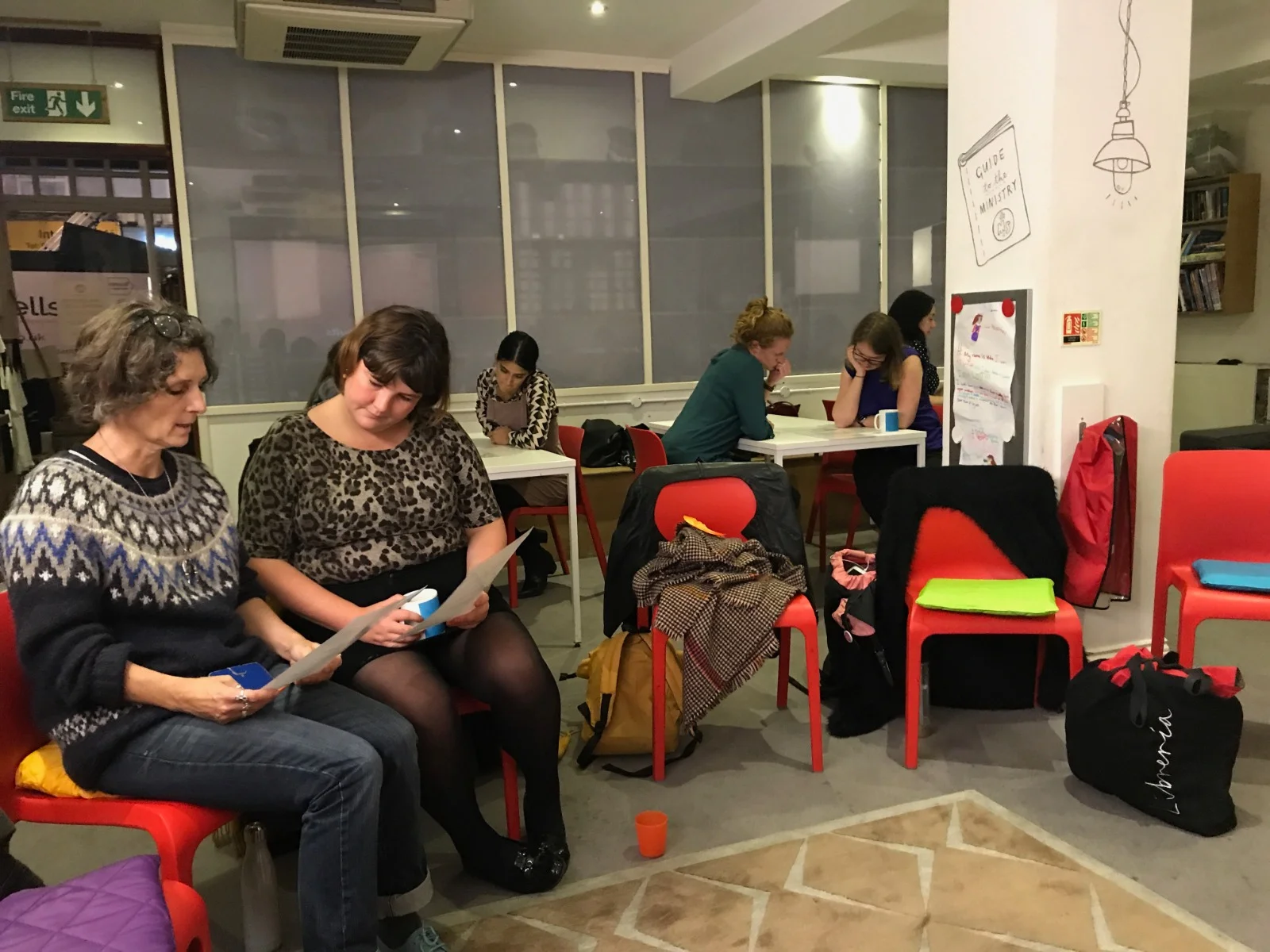
Session two took place at the magical Ministry of Stories, a home for mentoring and storytelling in Hoxton: the perfect fit for this session. We began with a check-in, asking everyone to tell us about their first mentoring meetings… We heard stories of pairs who clicked immediately, their mentees greeting them with huge hugs; stories of mentees teaching mentors phrases in their mother tongue; stories of mentors who’s nerves were immediately appeased by mentees who were chatty and warm. And we also heard stories of mentors who felt nervous about the language barriers, as well as others who were at times unsure of how much to fill the inevitable silences that arise when meeting a new person for the first time.
So it was fitting that this session was all about exploring communication tools and techniques. We looked at how drawing can help someone to articulate their goals; using Dixit cards as conversation starters; getting to grips with the concept of scaling as a mentoring tool, and much more. We unpicked coaching models, including TGROW, OSCAR and CLEAR, analysing how useful each one may (or may not) be in their individual mentoring relationships.
By the time we came to our second check-in of the evening, it was already 8pm, yet our mentors were feeling 'grateful, open, engaged, inspired, excited, positive, motivated, determined, curious and contemplative,’ which provided the perfect ground on which to move on to some more communication training, this time with social entrepreneur, Laura Macartney. Laura has a background in forum theatre, conflict resolution and inter-generational facilitation. She drilled us in how to be effective, compassionate and non-directive communicators, sending our mentors off, heads buzzing with tools, techniques and activities, ready to meet their mentees for a second time.
Session Three: Leadership
Our third and final training session focussed on leadership, and we were lucky enough to hear from three brilliant leaders, who shared with us their own distinct definitions of leadership.
We heard from Amy Cooper about how mentoring can be used as a space for digestion and how growth comes in moments of collaboration and sharing; she talked about how mentoring can illuminate possibilities, identify drains, remove blocks and build bridges.
Accenture’s Roshni Patel then walked us through her own experiences and definitions of leadership, centred around five pillars: be yourself; be curious and learn; build strong teams; have fun; strive to make a positive impact.
Finally, we heard from Cat Totty, whose experiences as a West End theatre director informed the way that she understands and practises leadership today. She talked about her work as a brand development consultant and the ways in which she has learnt to managed teams and individuals to get the most out of everyone she works with.
In the discussion that followed, we touched upon using reflection as a learning tool, building non-hierarchical relationships, communicating across language and cultural barriers and more...
What next?
With these three training sessions behind them, our mentors will continue to meet up over the next seven weeks. They will share advice and resources, draw on one another for support and guidance, and come together to reflect on their mentoring experiences, all with support from the Routes team.
We can’t wait to see their mentoring relationships develop and grow between now and Christmas!